

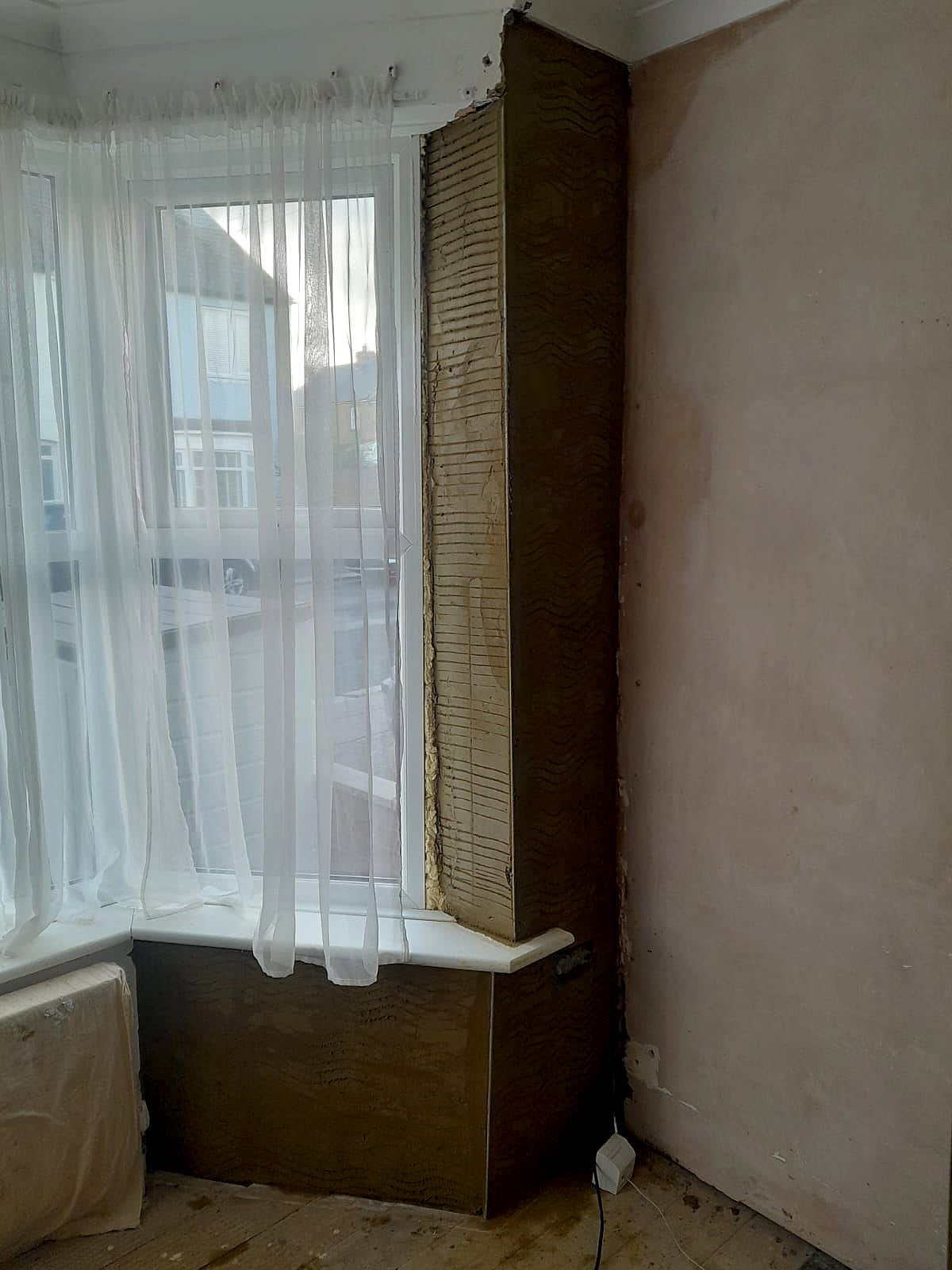
Partition Walls
Serving Broadstairs, Ramsgate, Margate, Canterbury, Dover and surrounding areas
Need to divide a large room into two, create an en-suite, or add a utility room? Partition walls are the answer. We build stud walls using metal or timber frameworks, insulated for sound, and finished with plasterboard and a skim coat to give you a solid, professional result.
What Is a Stud Partition Wall?
A stud partition wall is a non-load-bearing wall built from a framework (or “stud work”) of vertical members clad on both sides with plasterboard. The cavity between the boards is typically filled with insulation for acoustic performance. Once skimmed and decorated, a well-built partition wall is indistinguishable from the original walls of the house.
Partition walls are one of the most effective ways to reconfigure the layout of your home without major structural work. They are lighter than blockwork walls, can be installed quickly, and can be removed in the future if you want to open the space up again.
Lee on metal vs timber studs
My preference is timber. I’ve used both for years and metal studs are perfectly good, but I’ve got more experience with timber framing and it’s what I default to. The main practical reason is that timber gives you something to screw into anywhere you like, so if a customer wants to mount a TV or a heavy shelf later, it’s straightforward. Metal stud is good too, especially where weight matters or you need a perfectly straight wall, and I’ll use it where the job calls for it. But on a standard domestic partition where I’m building a wall to last, timber is what I reach for first.
When You Might Need a Partition Wall
Creating an En-Suite
One of the most common reasons for a partition wall in East Kent homes. A large bedroom can be divided to create a bedroom with an en-suite bathroom. The partition wall needs to accommodate plumbing, potentially carry a wall-hung basin or WC, and provide adequate sound insulation.
Dividing a Large Room
Open-plan living does not suit everyone. If you have a large through-room and want separate spaces - a dining room and a living room, a playroom and a study, a bedroom and a dressing area - a partition wall is the straightforward solution.
Loft and Garage Conversions
Converting a loft or garage into habitable space almost always requires partition walls. Loft conversions need partitions to create rooms, corridors and storage areas. Garage conversions may need a partition to separate the new room from a remaining storage area.
Home Offices
The shift to working from home has created huge demand for dedicated office spaces. A partition wall can carve out a proper home office from part of a bedroom, dining room or landing space - giving you a separate, quiet room with a door that closes.
Property Development and HMOs
Landlords and developers frequently need rooms divided for bedsits, studios or HMO (House in Multiple Occupation) accommodation. These projects often have specific fire rating, sound insulation and Building Regulations requirements that we are experienced in meeting.
Lee on what customers ask for
The most common reason is splitting up rooms to make more space, an extra bedroom, an en-suite, a home office carved out of a bigger room. That’s been steady for years. The newer trend that’s really taken off is garden rooms and outbuildings, people putting up structures in the back garden as office space, gym space, or just extra living space without going through the planning process for a full extension. Demand for that’s gone up significantly in the last few years and I’m doing more of those than I used to.
Metal vs Timber Studs
Metal Stud (C-Stud and Track System)
We most commonly use British Gypsum GypStud or equivalent metal stud systems. These consist of:
- Floor and ceiling track (U-channel) fixed to the floor and ceiling to hold the vertical studs
- C-studs (vertical members) slotted into the tracks at typically 400mm or 600mm centres
- Noggins (horizontal bracing) fitted between studs where needed
Advantages of metal studs:
- Perfectly straight - they do not bow, warp or twist like timber
- Lightweight - easier to handle and less load on the floor
- Non-combustible - better fire performance
- Consistent dimensions - boards fit predictably
- Resistant to moisture and rot
Timber Stud
Traditional stud partitions use sawn timber (typically 75mm x 50mm or 100mm x 50mm), with a sole plate on the floor, a head plate on the ceiling and vertical studs at 400-600mm centres.
Advantages of timber studs:
- Easier to fix heavy items directly into the studs
- More familiar to multi-trade builders
- Better suited to some older properties
- Can be used structurally if needed (with engineering)
We recommend the most appropriate system for each project. In most domestic situations, metal studs are our first choice for their precision and performance.
Sound Insulation
Sound transfer through partition walls is one of the biggest concerns for homeowners. Nobody wants to hear everything happening in the next room. We take acoustic performance seriously and offer several levels of sound insulation:
Standard Specification
Single metal stud frame, 50mm or 75mm mineral wool insulation (Rockwool or Knauf Acoustic Roll), 12.5mm plasterboard on each side. This provides adequate sound reduction for most domestic situations - hallway dividers, bedroom-to-dressing room partitions, home office walls.
Enhanced Specification
Single metal stud frame, full mineral wool insulation, double 12.5mm plasterboard on each side (known as a “double-boarded” wall). The additional mass significantly improves sound reduction and is recommended for bedroom-to-bedroom partitions or walls between living spaces and home offices.
High-Performance Specification
For situations demanding the best acoustic performance - walls between a living room and a bedroom, music rooms, or HMO partitions - we can specify:
- Resilient bars between the plasterboard and studs, which decouple the board from the frame and dramatically reduce sound transfer through the structure
- Acoustic-grade plasterboard (such as Gyproc SoundBloc) which has a higher mass than standard board
- Twin-stud systems with separate frames for each side, eliminating any structural connection between the two faces of the wall
Lee on acoustic walls
Most domestic partition jobs get standard mineral wool insulation, which is fine for separating a bedroom from a dressing area or a home office. Where acoustic performance really matters, I’ll use acoustic boards specifically designed for soundproofing. I’ve fitted those in some unusual places, including a job in a radio station where the brief was to get the ambient noise as low as possible. Different boards, different insulation, more attention to how the board is fixed to the frame. People underestimate how much difference proper acoustic detailing makes, but you really notice it when you stand on either side of the finished wall.
Our Process
1. Planning
We discuss the wall’s position, height, any door openings, services to be incorporated (electrical sockets, light switches, plumbing), and the level of sound insulation required. We mark out the wall position on the floor and check for any existing services that might conflict.
2. Framework
Floor and ceiling tracks are fixed in position, checked for level and square. Vertical studs are cut and fitted at the planned centres. Door openings are framed with doubled-up studs and a reinforced head for strength. Timber noggins are installed wherever heavy items will be wall-mounted.
3. First-Side Boarding
Plasterboard is fixed to one side of the framework. Boards are cut to fit around obstacles and screwed at regular centres. This creates one face of the wall and defines the cavity for insulation.
4. Services and Insulation
With one side boarded, services are installed in the cavity - the electrician runs cables and fits back boxes for sockets and switches, the plumber runs any necessary pipework. Once services are in place, mineral wool acoustic insulation is fitted throughout the cavity.
5. Second-Side Boarding
The second layer of plasterboard is fitted, enclosing the insulation and services. All joints are taped with scrim, and the wall is ready for finishing.
6. Skimming and Finishing
Both sides of the wall are skimmed with Thistle Board Finish to create smooth, seamless surfaces. External corners and edges receive metal angle bead. The finished wall is ready for decoration once dry.
Lee on coordinating with other trades
On a partition wall job, I’m coordinating closely with whoever’s running services through the wall. The usual sequence is: I build the frame, one side gets boarded, then the electrician runs cables and back boxes and the plumber runs pipes if there’s plumbing involved. Once first fix is done, I fit the insulation, board the second side, and skim both faces. Then the electrician and plumber come back for their second fix. Good communication on day one stops problems on day five, so I’ll always ask the customer who’s doing what and when before I start framing.
Fire Rating
Where Building Regulations require it (particularly in flats, HMOs and properties converted to multiple dwellings), partition walls must achieve specific fire resistance ratings, typically 30 or 60 minutes. We achieve this through:
- Gyproc FireLine board (pink board) which has enhanced fire resistance
- Double boarding to increase the fire rating
- Fire-stopping all service penetrations with intumescent compounds
- Correct specification of the entire system to match the required rating
We are familiar with the requirements of Part B of the Building Regulations and can specify walls to meet the necessary standards.
Frequently Asked Questions
What is a partition wall?
How thick is a partition wall?
Can I hang things on a partition wall?
How soundproof is a partition wall?
Do partition walls need Building Regulations approval?
Can a partition wall include a door?
How long does it take to build a partition wall?
Metal studs or timber studs - which is better?
Ready to Get Started?
Contact us today for a free, no-obligation quote on your partition walls project. We serve all areas across East Kent.
What Customers Say About Our Partition Walls
5.0Lee has been helping me transform my bungalow over the last couple of years. I've been very happy with his work and his rates. A jolly decent chap as well ! Thanks Lee.
5.0Lee is friendly, knowledgeable, reliable, affordable - and an excellent plasterer! We are very happy with his work and will definitely use him again. Thoroughly recommended.
5.0Positive: Responsiveness, Punctuality, Quality, Professionalism, Value