

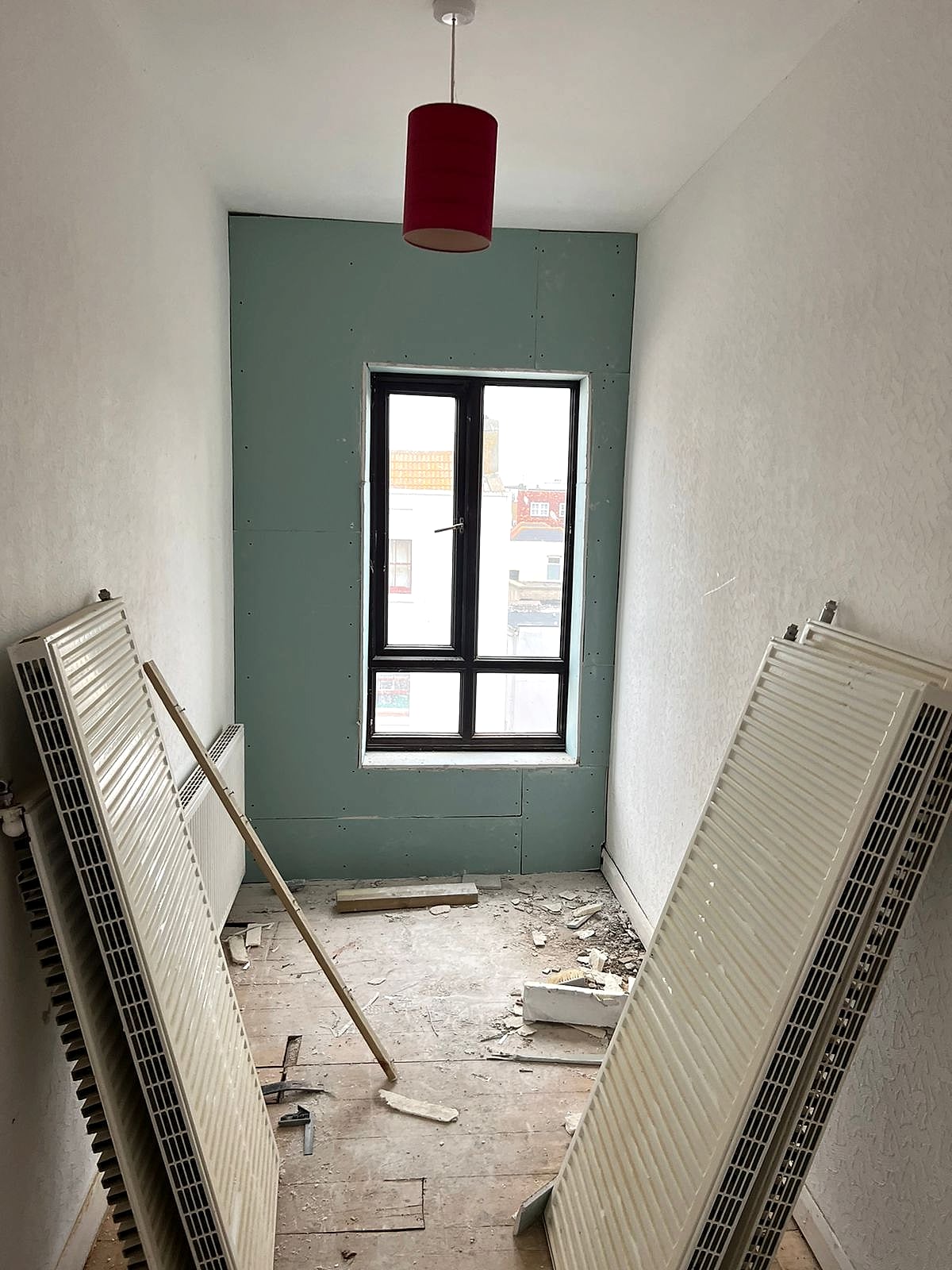
Dry Lining
Serving Broadstairs, Ramsgate, Margate, Canterbury, Dover and surrounding areas
Dry lining involves fixing plasterboard to walls to create a flat, even surface for plastering and decoration. Whether you need to straighten out uneven masonry, add insulation, conceal pipework and cables, or simply get a room ready for finishing, dry lining is a fast and effective solution.
What Is Dry Lining?
Dry lining is the process of fixing plasterboard sheets to the interior face of walls to create a flat, smooth surface that is ready for a skim coat of plaster and then decoration. It is called “dry” lining because the boards are fixed mechanically or with adhesive rather than with wet plaster backing coats.
There are two main methods:
Dot and Dab
Plasterboard is fixed directly to the masonry wall using blobs of British Gypsum Gyproc Dri-Wall Adhesive. The adhesive dabs are applied in a grid pattern to the wall, and the board is pressed into position and levelled. This method is quick and minimises the loss of room space, adding only around 10-15mm to the wall thickness.
Dot and dab works best on reasonably flat walls where the unevenness is no more than about 10-15mm. It is the standard method used in most new-build homes across the UK.
Battened (or Framed) Dry Lining
Timber or metal battens are fixed horizontally or vertically to the wall, and plasterboard is screwed to the battens. This method is used when:
- Walls are significantly uneven (more than 15mm variance)
- Insulation needs to be fitted between the battens
- Cables or pipework need to run behind the boards
- An air gap is needed for ventilation (particularly in older, damp-prone properties)
Battened dry lining uses more room space (typically 25-50mm depending on batten depth) but offers much more versatility.
Lee on dot and dab vs battens
I do both, and it depends on the wall and the job. Dot and dab is quicker, takes up less room, and on a reasonably flat wall it’s the right call. But I’ve had jobs where dot and dab caught me out: pulled the boards off an old wall once and the whole column of bricks came out with them, because the bricklayer who put the wall up years ago hadn’t done a proper job. So if the wall is at all suspect, I’ll batten it out. Battens are also the answer if you want insulation behind the board, services running across the wall, or you need to plumb up a wall that’s badly out. Right method for the right wall, no shortcuts.
When Dry Lining Is the Right Approach
Uneven Walls
Many East Kent properties, particularly older ones, have walls that are far from flat. Original plaster may have been applied to rough masonry with little regard for straightness, or the walls themselves may have moved over time. Dry lining allows us to create perfectly flat, plumb wall surfaces regardless of what is behind.
Adding Insulation
Dry lining is often combined with insulation, particularly for solid-walled properties that cannot have cavity wall insulation. Kingspan or Celotex insulated plasterboard, or mineral wool insulation fitted between battens, can dramatically improve the thermal performance of a room. Many 1930s-1960s East Kent homes have solid 9-inch brick walls that lose heat rapidly - internal insulated dry lining is often the most practical solution.
Lee on insulation choices
Insulation comes up more and more, particularly with energy prices the way they are. My go-to products are Kingspan and Celotex for walls and ceilings, and Rockwool in loft areas. Celotex is easier to fit in larger gaps, more forgiving on slight unevenness, so that gets used a lot. Kingspan is excellent where you need maximum thermal performance in a tight space. We do the whole job: insulation, boarding and skimming, so the customer isn’t juggling three trades to get one room finished.
Hiding Services
When electricians or plumbers need to run cables and pipes across wall surfaces, dry lining provides a neat way to conceal them. Rather than chasing channels into masonry (which is noisy, dusty and can weaken the wall), services can be run behind plasterboard and accessed later if needed.
Replacing Failed Plaster
When existing plaster is beyond repair - extensively blown, crumbling or affected by damp - dry lining over the top (after treating any underlying issues) can be quicker and more cost-effective than hacking off the old plaster and starting with wet backing coats.
New Extensions and Conversions
Most new block walls in extensions, garage conversions and loft conversions are dry lined rather than wet plastered. The speed of installation makes it the go-to choice for builders looking to progress through a project efficiently.
Our Process
1. Survey and Planning
We measure the room, check wall conditions and discuss your requirements. If insulation is part of the plan, we calculate the appropriate thickness and type. We identify where services run and plan board layouts to minimise waste and ensure joints fall in sensible positions.
2. Preparation
Existing walls are cleared of loose material, old fixings and debris. If damp is present, it must be addressed before dry lining begins. For battened systems, we mark out and fix the battens, checking each one for level and plumb. For dot and dab, we ensure the wall surface is suitable for adhesive.
3. Board Fixing
We use Gyproc WallBoard for standard applications, Gyproc Moisture Resistant (MR) board in kitchens, bathrooms and areas prone to humidity, and Gyproc FireLine where fire resistance is required (such as garage conversions or party walls). Boards are cut precisely to fit around windows, doors and obstacles.
All boards are fixed securely, whether by adhesive dabs or screws to battens. Joints are staggered where possible, and scrim tape is applied to all joints before skimming.
Lee on specialist boards
I use the right board for the situation. Fireline boards for ground floors and basements where the regs require fire resistance. Moisture-resistant boards for bathrooms and basements, anywhere with persistent humidity. Acoustic boards for soundproofing in rooms where noise matters, I’ve fitted those in radio studios and rooms backing onto busy roads. Standard board for most jobs. People underestimate how much difference the right board makes, especially on the moisture and acoustic side.
4. Finishing
Once the boards are fixed, the wall is skimmed with Thistle Board Finish to create a seamless, smooth surface. Metal angle beads are fitted to all external corners, and reveals around windows and doors are finished to match.
Materials We Use
- Gyproc WallBoard (12.5mm) - standard plasterboard for most applications
- Gyproc Moisture Resistant - for bathrooms, kitchens and humid areas
- Gyproc FireLine - where fire resistance ratings are required
- Gyproc Dri-Wall Adhesive - for dot-and-dab fixing
- Thistle Board Finish - for skimming the finished boards
- Kingspan Kooltherm K118 or Celotex PL4000 - insulated plasterboard options
- Rockwool or Knauf mineral wool - for insulation between battens
- Galvanised metal or treated timber battens
- Gyproc Scrim Tape and metal angle bead
Dry Lining in Period Properties
Older properties in Canterbury, Deal, Sandwich and across East Kent need careful consideration. Solid stone or brick walls that have survived for hundreds of years do so because they can breathe - moisture passes through the wall and evaporates from the surfaces. Sealing these walls behind standard plasterboard with a vapour barrier can trap moisture, leading to damp, mould and even structural damage.
For period properties, we may recommend:
- Leaving an air gap behind the plasterboard to allow ventilation
- Using breathable insulation materials rather than foil-backed boards
- In some cases, using lime plaster on the masonry surface before dry lining over the top
Each property is different, and getting this right is important for the long-term health of the building.
Lee on older properties
Older buildings need to breathe. That’s the rule. If you slap modern dry lining with a foil-backed board onto an old solid wall and seal it up, you’ll trap moisture in the wall and you’ll be back inside a year fixing damp problems. On period homes I’ll either batten out with an air gap behind the board, use breathable insulation rather than foil, or in some cases apply lime plaster to the masonry first and then dry line over the top. It’s slower and it costs more, but on a property that’s stood for 200 years, you don’t want to be the one who broke it. I’ve seen too many damp jobs that started as “just dry line over the old plaster” and ended up costing the customer more to put right.
Cost Factors
The cost of dry lining depends on several factors:
- Room size - more wall area means more materials and time
- Method - dot and dab is typically cheaper than battened dry lining
- Insulation - adding insulation increases material costs
- Board type - moisture-resistant and fire-rated boards cost more than standard
- Complexity - lots of windows, doors, alcoves and obstacles increase labour time
- Condition of existing walls - preparation work on poor surfaces adds time
We provide a clear, itemised quote before starting any work so you know exactly what to expect.
Frequently Asked Questions
What is the difference between dry lining and plastering?
Why would I choose dry lining over wet plastering directly onto the wall?
Does dry lining reduce room size?
Can I still hang heavy items on dry-lined walls?
Is dry lining suitable for old stone walls?
How long does dry lining take?
Do you dry line ceilings as well?
Ready to Get Started?
Contact us today for a free, no-obligation quote on your dry lining project. We serve all areas across East Kent.
What Customers Say About Our Dry Lining
5.0Downstairs Hall ceiling, Overboard and skim.
Good Job, competitively priced, more than happy with the work. Would not hesitate to recommend him. In fact a "Perfect" job.
5.0Removed old ceiling and and put new plasterboard up and then plastered ceiling and damaged walls
I wanted to write a review as I nearly didn't pick Lee due to 1 bad review but after seeing it was only 1 out of so many I thought I would give him the benefit of the doubt ! I am so glad I did because the workmanship was outstanding! The finish of the plastering is superb. Lee was easy to contact throughout my decision making and sent a prompt quote shortly after. As people may know getting hold of builders these days is hard work! But Lee was great. Not only was his workmanship superb but so was his cleanliness. I will use Lee again as I have some more work planned in the summer.
5.0Plaster boarding and skimming the whole bathroom walls and ceiling.
We called on Lee at short notice, last week. We needed a plasterer ASAP, as we had been without a bathroom for over 3 weeks. Lee started the work on 21/09 and all completed by the 23/09. Very pleased, as we can now order our bathroom. Thanks Lee