

Damp Proofing
Serving Broadstairs, Ramsgate, Margate, Canterbury, Dover and surrounding areas
Damp is one of the most common problems in East Kent homes, from rising damp in Victorian terraces to penetrating damp in exposed coastal properties. Our damp-proofing plastering service addresses the symptoms and the causes, using specialist plasters and treatments to give you dry, healthy walls.
Damp in East Kent Homes
East Kent’s proximity to the coast, combined with its mix of property ages and construction types, means damp is a particularly common problem. Coastal properties in Deal, Walmer, Broadstairs and Margate face driving rain and salt-laden air. Older properties in Canterbury and the surrounding villages may have failing damp proof courses or none at all. Post-war homes with flat roofs or poor detailing can suffer from penetrating damp that goes unnoticed for years.
Whatever the cause, damp walls are not just unsightly - they are unhealthy. Damp promotes mould growth, which can cause respiratory problems, and it damages decoration, furniture and the building fabric itself.
Lee on damp in East Kent
Damp proofing accounts for about half of all the work I do. That’s half. It’s a huge part of the trade in East Kent, much more than people who haven’t lived here realise. The worst areas are the coastal ones, Margate, Cliftonville, Herne Bay, Sandwich. Sandwich in particular is one of the worst for damp problems. A lot of it ties back to poor ventilation in older properties: original windows replaced with double glazing but no extractor fans put in, blocked air bricks, no thought given to how the building was designed to breathe. Coastal exposure makes everything worse, salt in the walls, driving rain on the windward side, and you’ve got damp problems that just won’t go away unless you treat them properly.
Types of Damp
Rising Damp
Rising damp occurs when ground moisture is drawn upward through the wall by capillary action. It typically affects the lower portion of ground-floor walls, usually up to about 1 metre but sometimes higher. Tell-tale signs include:
- A tide mark on the lower wall, often with white salt deposits
- Peeling or blistering paint or wallpaper at low level
- Damp, musty smell at skirting board level
- Deteriorated or crumbling plaster at the base of walls
Rising damp is controlled by a damp proof course (DPC) - a physical or chemical barrier within the wall that stops moisture rising above ground level. Many older East Kent properties either lack a DPC or have one that has deteriorated over time. External ground level can also rise above the DPC (due to raised paths, patios or flower beds), effectively bypassing it.
Penetrating Damp
Penetrating damp comes through the wall from outside. Common causes include:
- Failed or missing pointing between bricks, allowing rain to soak in
- Cracked or deteriorated render that no longer sheds water
- Defective gutters and downpipes directing water onto walls
- Failed flashings around roofs, chimneys and abutments
- High external ground levels directing surface water against the wall
In exposed East Kent locations, particularly coastal areas facing prevailing south-westerly weather, penetrating damp is extremely common on the windward side of properties.
Condensation
The most common form of damp in UK homes, condensation is caused by warm, moist air contacting cold surfaces. Modern lifestyle (drying clothes indoors, reduced ventilation from double glazing, cooking, bathing) produces large amounts of moisture that needs to escape. When this moisture-laden air hits a cold wall, it condenses into water droplets.
Condensation typically shows as black mould growth on cold walls, in corners, behind furniture and around windows. It is often misdiagnosed as rising or penetrating damp.
Lee on condensation vs rising damp
More often than people think. A good chunk of the “rising damp” calls I get are actually condensation. Customer sees black mould on a wall and assumes the worst, but a lot of it is lifestyle damp: drying clothes indoors, no extractor in the bathroom, windows kept shut to save heat, no ventilation in the property. I’ll always have a proper look first and tell people straight whether it’s a plastering job, a damp specialist job, or just a ventilation problem they can fix themselves. If I’m not sure it’s a plastering problem, I’ll send someone to JCW, who I work with for serious damp diagnosis. There’s no point me plastering a wall if the cause hasn’t been dealt with, it’ll come straight back through.
Our Damp-Proof Plastering System
Once the cause of damp has been identified and addressed (whether that is a new DPC injection, external repairs, improved ventilation or other remedial work), we apply a specialist plastering system designed for damp conditions.
Step 1: Removal of Contaminated Plaster
Existing plaster on damp-affected walls is removed back to bare masonry, typically to a height of at least 300mm above the visible tide mark. This plaster is contaminated with hygroscopic salts that have been drawn from the masonry by moisture. These salts attract moisture from the air even after the wall is dry, so the contaminated plaster must go.
Step 2: Preparation
The exposed masonry is raked out and cleaned. Joints are brushed out to remove loose mortar and any salt deposits are brushed or washed away. The wall surface needs to be clean and sound for the specialist plaster to bond properly.
Step 3: Salt-Retardant Render
We apply a specialist renovating plaster system. The products we use include:
- Dryzone Damp-Resistant Plaster or Limelite Renovating Plaster - these are formulated to resist salt contamination and moisture
- Renderoc HB or similar cementitious base coats where a tanking function is also needed
- Vandex or Sika cementitious tanking slurries for basement and below-ground applications
These products differ from standard gypsum plaster in several important ways: they are cement-based (not gypsum), they resist salt migration, they allow controlled moisture vapour transmission, and they are far more durable in damp conditions.
Lee on the products he uses
For damp proofing I commonly use Ka tanking slurry. It’s effective for sealing against dampness, it’s strong enough to seal a swimming pool, that’s the kind of stuff. Sika is the high-quality alternative, more expensive but excellent. The key with tanking slurry is applying it correctly. Especially in basements, you have to dig down into the floor joints by the walls, two or three inches, and create a fillet, a small skirting-like lump that stops water seeping into the wall at the floor junction. Skip the fillet and water will track around your tanking and you’ve wasted the job. People think tanking is just painting it on the wall, it isn’t.
Step 4: Finishing
The renovating plaster is typically finished with a compatible finishing coat or floated to a smooth surface suitable for decoration. In some cases, a final skim of specialist finishing plaster is applied. The finish may have a slightly different texture to standard gypsum plaster, but once painted, the difference is negligible.
Step 5: Drying
Damp-proof plasters take longer to dry than standard gypsum plaster - typically 4-6 weeks, sometimes longer in poorly ventilated areas. We advise on ventilation and heating to optimise drying time and recommend waiting until the surface is fully dry before decorating.
Basement Tanking
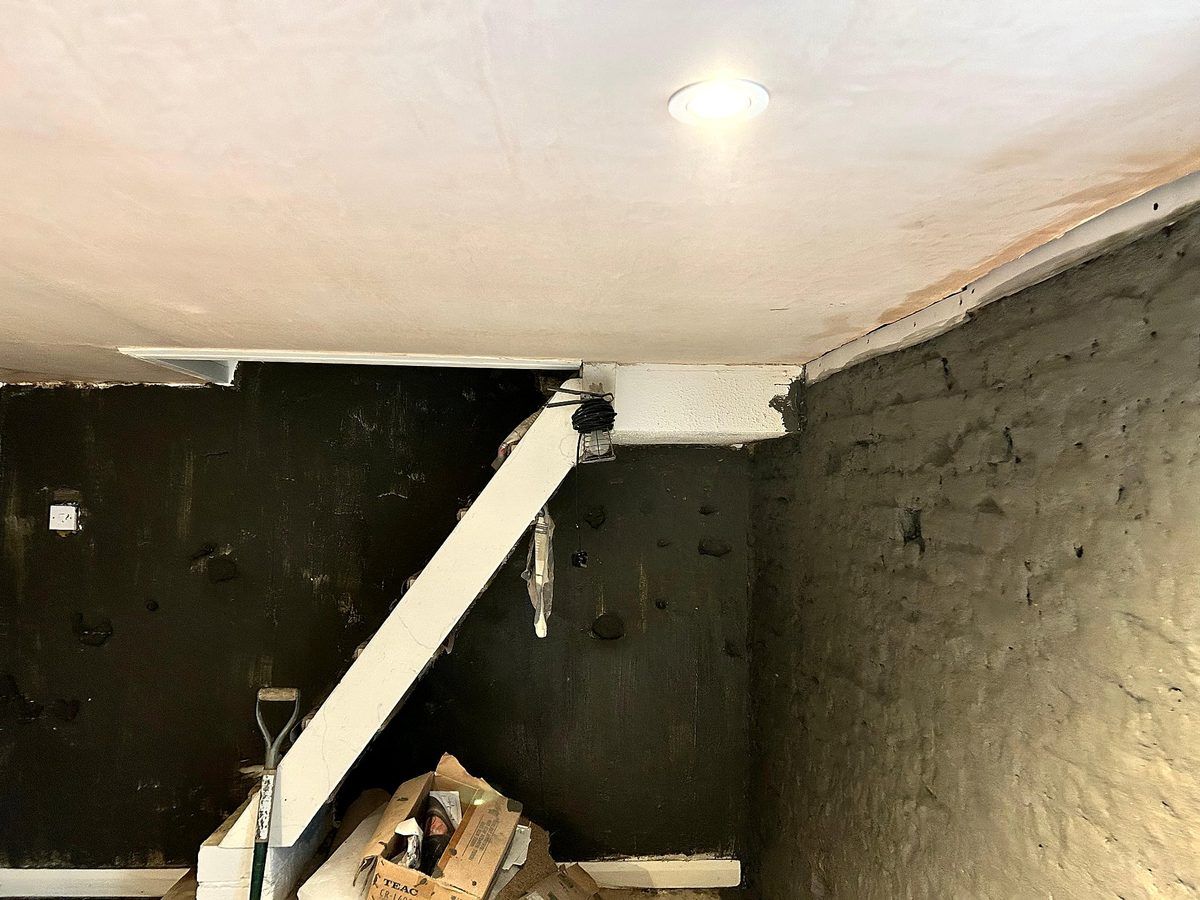
For basements and below-ground rooms, the challenge is more severe. Water pressure from the surrounding ground can force moisture through walls and floors. Standard damp-proof plaster is not sufficient in these conditions.
We use cementitious tanking systems that create a waterproof barrier capable of withstanding hydrostatic pressure. Products like Vandex Super or Sika 1 are applied to the masonry in multiple coats, forming a rigid, waterproof membrane. The tanking is then covered with a renovating plaster system to create a finished wall surface.
Basement tanking is more specialised work and typically costs more per square metre than standard damp-proof plastering, but it is the only reliable way to waterproof a below-ground space.
Lee on basement tanking
Basement work comes up regularly enough, and the principle is the same as any tanking job but the consequences of getting it wrong are higher because you can’t easily get back in to fix it later. You’re sealing against water pressure from outside the wall, so the slurry has to be applied properly across the whole surface and detailed correctly at the floor junction with that fillet. Once it’s sealed, you can plaster over the top with a renovating plaster and finish it like any other room. I won’t take on injection damp-proofing myself, that’s a specialist job and I’ll send those to JCW.
Prevention and Advice
We always advise customers on measures to prevent damp returning:
- Keep external ground levels below the DPC - patios, paths and flower beds should be at least 150mm below the damp proof course
- Maintain gutters and downpipes - clear them annually and repair any leaks promptly
- Ensure adequate ventilation - use extractor fans in kitchens and bathrooms, open windows where practical, and avoid blocking air bricks
- Avoid drying clothes on radiators without ventilation - this puts enormous amounts of moisture into the air
- Maintain external render and pointing - damaged render and missing pointing are open invitations for rain penetration
Working with Damp Specialists
For complex or severe damp problems, we work alongside specialist damp surveying and treatment companies. Where a chemical DPC injection is needed, we coordinate with the injection team so that the plastering work follows on at the correct time. This ensures a seamless process for you without having to manage multiple trades yourself.
Lee on who he works with
For serious damp work, injection damp-proofing, full surveys, anything that needs a damp specialist’s name on the report, I work with JCW damp proofing and plastering. They handle the technical damp side, I handle the plastering and finishing. That partnership means customers get the right diagnosis from a specialist plus the right plastering system applied properly afterwards. It’s how it should be done, neither of us pretending to be the other.
Frequently Asked Questions
What is the difference between rising damp, penetrating damp and condensation?
Do I need a damp proof course?
Can you just plaster over damp?
What is tanking?
How long does damp proof plastering take to dry?
Will the damp come back after treatment?
Is damp proofing covered by insurance?
My house smells musty - is that damp?
Ready to Get Started?
Contact us today for a free, no-obligation quote on your damp proofing project. We serve all areas across East Kent.
What Customers Say About Our Damp Proofing
5.0Lee has been helping me transform my bungalow over the last couple of years. I've been very happy with his work and his rates. A jolly decent chap as well ! Thanks Lee.
5.0Lee is friendly, knowledgeable, reliable, affordable - and an excellent plasterer! We are very happy with his work and will definitely use him again. Thoroughly recommended.
5.0Positive: Responsiveness, Punctuality, Quality, Professionalism, Value