

Insulation
Serving Broadstairs, Ramsgate, Margate, Canterbury, Dover and surrounding areas
Many East Kent homes were built with solid walls that lose heat far faster than modern insulated cavities. Internal wall insulation combined with dry lining is one of the most effective ways to improve your home's energy efficiency, reduce heating bills and make rooms noticeably warmer and more comfortable.
The Problem with Solid Walls
A significant number of homes across East Kent were built before cavity wall construction became standard in the 1930s. Victorian terraces in Deal and Dover, Edwardian semis in Canterbury, and even many interwar properties have solid brick or stone walls with no cavity and no insulation.
These walls are typically 225mm (9 inches) of solid brick, or in some cases solid ragstone or flint. They conduct heat rapidly: on a cold Kent winter day, you can often feel the chill radiating from an uninsulated solid wall even when the heating is running. The result is higher energy bills, uncomfortable cold spots and rooms that never seem to warm up properly.
Lee on when insulation comes up
Insulation comes up a lot, both because customers actively want to lower their energy bills and because I’ll flag it as an option when I’m pricing a job that involves taking walls back. If we’re already replastering a room, adding insulation at the same time is a much cheaper way to improve the property than doing it as a standalone project later. The most common properties I’ll insulate are Victorian and Edwardian solid-walled homes across East Kent, and 1930s semis with no cavity. Those are the ones that lose the most heat through the walls.
Internal Wall Insulation: How It Works
Internal wall insulation (IWI) involves adding a layer of insulating material to the inside face of external walls, then covering it with plasterboard to create a finished surface ready for decoration. There are several approaches:
Insulated Plasterboard (Thermal Laminate)
Pre-bonded insulated plasterboard, such as Kingspan Kooltherm K118 or Celotex PL4000, combines a rigid insulation board with plasterboard already bonded to it. These can be fixed directly to the wall using adhesive dabs or mechanical fixings.
This is one of the most common methods for straightforward solid wall insulation. The insulation thickness ranges from 25mm to 100mm depending on the thermal performance required, with the plasterboard adding another 12.5mm.
Battened System with Mineral Wool
Timber or metal battens are fixed to the wall, and insulation - typically Rockwool or Knauf mineral wool - is fitted between the battens. Plasterboard is then screwed to the battens over the top. This method works well when walls are uneven, as the battens can be packed and levelled, and is a good choice when you also need to run services behind the boards.
Rigid Board Between Battens
Similar to the mineral wool method, but using rigid PIR boards (such as Celotex or Kingspan) cut to fit between the battens. This gives higher insulation performance per millimetre of thickness compared to mineral wool.
Lee on his preferred insulation products
My preferred products are Kingspan and Celotex for walls and ceilings, and Rockwool in loft areas. Celotex is easier to fit in larger gaps, which makes it forgiving on slightly uneven walls. Kingspan gives you maximum thermal performance in a tight space, which matters when you don’t want to lose too much room size. Rockwool is what I use for loft insulation and anywhere acoustic value matters. We do the whole job too: insulation, boarding, skimming, all under one roof. The customer doesn’t have to juggle three different trades to get one room finished.
Moisture Management
This is the critical aspect of internal wall insulation that separates a properly specified installation from a problematic one. When you insulate the inside of a wall, you change the way moisture moves through it. The wall behind the insulation becomes colder, which can cause condensation to form at the interface between the insulation and the masonry.
To manage this:
- Vapour control layers (VCL) are installed on the warm side of the insulation to limit the amount of moisture vapour reaching the cold wall. Some insulated plasterboard products have a foil facing that acts as an integral VCL.
- Junctions and edges are sealed with tape to prevent moisture bypassing the VCL at gaps around windows, doors, floors and ceilings.
- Breathable systems may be specified for older properties where trapping moisture could cause more harm than good. These use insulation materials that allow some moisture transfer while still providing thermal resistance.
We carry out a moisture risk assessment as part of our survey for every insulation project. Getting this wrong can lead to hidden damp and mould, so it is not something we take lightly.
The Process
1. Survey
We assess your property, measure the walls to be insulated, check for damp or existing moisture issues, and discuss your goals (warmth, energy saving, comfort). We then recommend the most appropriate insulation system and thickness.
2. Preparation
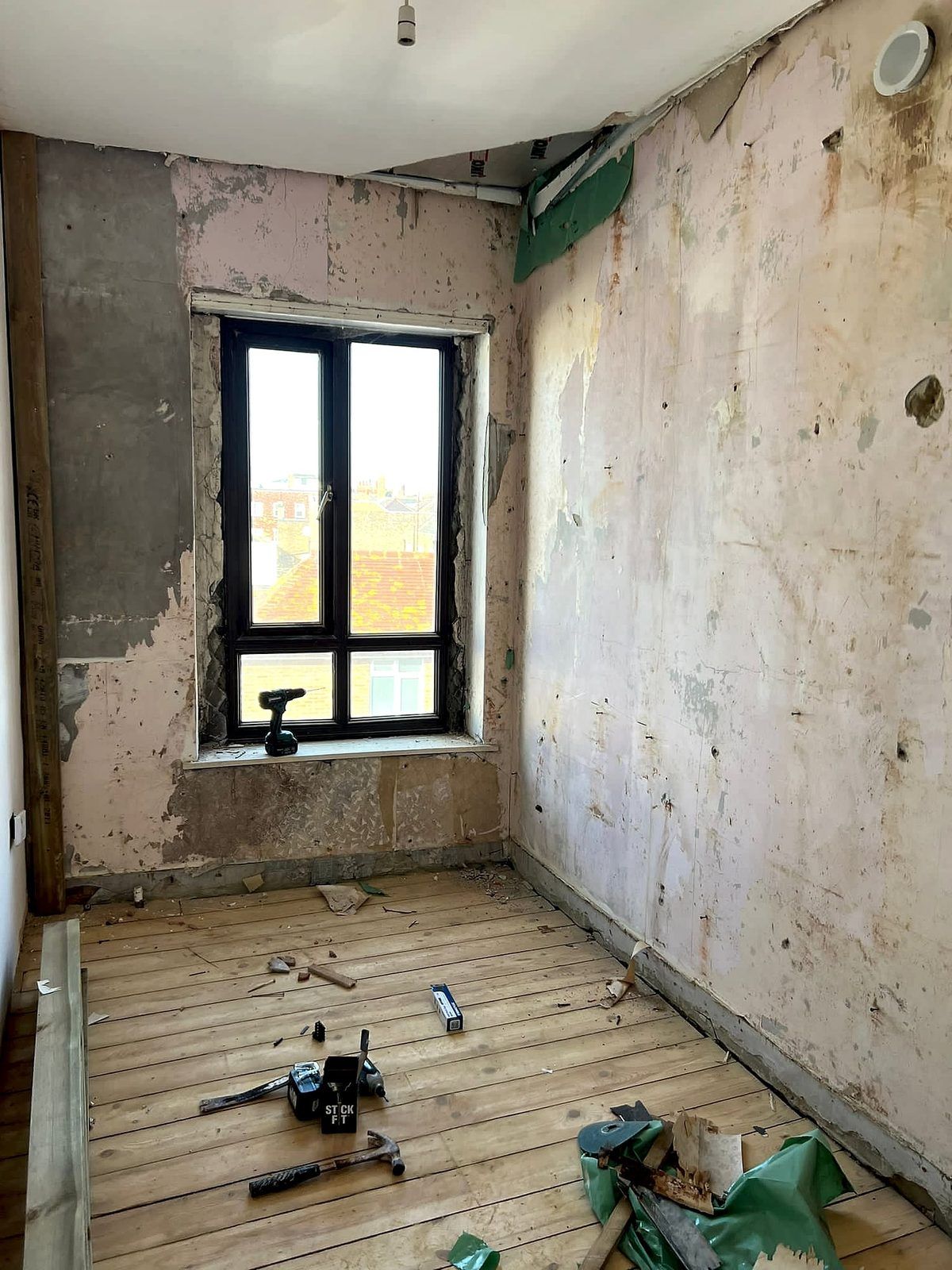
Existing wall surfaces are prepared. Loose plaster is removed, damp issues are addressed, and the walls are cleaned. Any existing services (cables, pipes) are either rerouted or accommodated within the new system.
3. Installation
The chosen insulation system is installed according to manufacturer specifications and best practice:
- Battens fixed and levelled (if using a battened system)
- Insulation fitted tightly with no gaps or cold bridges
- Vapour control layer applied and all junctions sealed
- Plasterboard fixed securely
4. Finishing
All joints are scrim taped, external corners receive metal angle bead, and the entire surface is skimmed with Thistle Board Finish to produce a smooth, seamless finish ready for decoration.
5. Making Good
Window reveals are insulated and dry lined to prevent cold bridges at the edges. Skirting boards are refitted, sockets and switches are repositioned on the new wall surface by a qualified electrician, and the room is left clean and ready for decorating.
Lee on window reveals
Reveals are the bit that catches people out on insulation jobs. If you insulate the wall but leave the window reveal as bare cold brick, you’ve created a cold bridge right at the edge of the window and that’s where condensation will form. So the reveals always get insulated and dry lined as part of the job, that’s not an extra. Customers don’t always realise that until I explain it, but it’s the difference between a job that works properly and one that creates a new damp problem.
Benefits
Lower heating bills - reducing heat loss through walls means your boiler works less hard to maintain a comfortable temperature.
Warmer rooms - insulated walls feel warmer to the touch and eliminate the cold-wall effect that makes rooms feel draughty even when windows are closed.
Reduced condensation - cold walls attract condensation and encourage mould growth. Insulation raises the wall surface temperature, reducing the risk.
Improved EPC rating - if you are planning to sell or let your property, wall insulation can significantly improve your Energy Performance Certificate rating.
Quieter rooms - insulation also provides acoustic benefits, reducing external noise transmission through the walls.
External Wall Insulation Alternative
While our core offering is internal wall insulation (which falls naturally within our plastering and dry lining expertise), we also carry out external wall insulation (EWI) as part of our rendering services. EWI involves fixing insulation boards to the outside of the building and covering them with a render system.
EWI is often preferable because it does not reduce internal room sizes and protects the building fabric from the outside. However, it changes the external appearance of the property, which may not be desirable or permitted in conservation areas. It is also more expensive.
We can discuss both options and help you decide which is right for your property and budget.
Lee on internal vs external wall insulation
Most of my insulation work is internal, because it fits naturally alongside the dry lining and plastering I’d be doing in the room anyway. External wall insulation comes up less often, partly because it changes the look of the property and isn’t allowed in conservation areas, and partly because it’s a bigger commitment for the customer. When I do EWI, it’s usually as part of a full external render system, so the insulation goes on the wall and the modern render goes over the top. Either route, I’ll do the whole job rather than leaving the customer to coordinate the insulation with whoever’s doing the finishing.
Frequently Asked Questions
How much can internal wall insulation save on heating bills?
Will insulation make my rooms smaller?
Is internal wall insulation suitable for period properties?
Do I need Building Regulations approval for internal wall insulation?
Can you insulate just one or two walls rather than the whole room?
What about condensation risk?
How long does the work take?
Is there any grant funding available?
Ready to Get Started?
Contact us today for a free, no-obligation quote on your insulation project. We serve all areas across East Kent.
What Customers Say About Our Insulation
5.0Lee has been helping me transform my bungalow over the last couple of years. I've been very happy with his work and his rates. A jolly decent chap as well ! Thanks Lee.
5.0Lee is friendly, knowledgeable, reliable, affordable - and an excellent plasterer! We are very happy with his work and will definitely use him again. Thoroughly recommended.
5.0Positive: Responsiveness, Punctuality, Quality, Professionalism, Value